MiniMax M2.7 improves itself
MiniMax M2.7 is a reasoning model built for coding, agentic workflows, and professional productivity. What makes MiniMax M2.7 stand out is the claim behind it: the model did not only help users solve tasks, it also helped improve the system used to develop and operate the model itself.
That sounds dramatic, so it helps to strip away the headline and look at the mechanics. MiniMax M2.7 is not a model that independently rewrites its own core training from scratch. The more accurate story is that it works inside a larger agent setup with memory, tools, skills, and evaluation loops, and it can help refine that setup over time. That matters because modern AI performance depends on more than model weights alone. In many real workflows, the surrounding system decides whether a model is merely good at answering prompts or genuinely useful over long tasks.
What is MiniMax M2.7
MiniMax M2.7 is a proprietary text model released in March 2026. It supports text input and text output and has a context window of about 200,000 tokens. That large context window gives it room to handle long instructions, big codebases, research notes, tool outputs, and ongoing task history in one session.
MiniMax positions M2.7 as a model for three kinds of work:
- Software engineering such as debugging, refactoring, code security, machine learning work, and full project delivery.
- Agentic workflows where the model works with tools, memory, structured skills, and other agents across many steps.
- Professional productivity including document editing, spreadsheet work, presentations, and complex business style tasks.
On paper, M2.7 looks strong in the areas where long horizon reasoning matters most. MiniMax reported 56.22 percent on SWE Pro, 55.6 percent on VIBE Pro, and 57.0 percent on Terminal Bench 2. It also reported strong results for office style work and tool use, including a GDPval AA ELO score of 1495 and 46.3 percent on Toolathon. Those numbers matter less as trophies and more as signals that M2.7 is being shaped for real world workflows instead of short prompt demos.
What self improvement means in practice
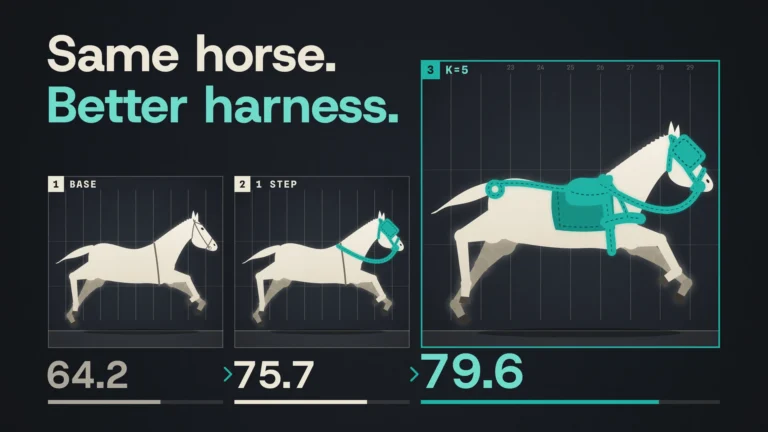
The phrase self improvement can easily be misunderstood. In the case of MiniMax M2.7, the important layer is the agent harness around the model. You can think of the model as the reasoning engine and the harness as the working environment that helps it do useful work.
That working environment can include persistent memory, tool access, structured skills, evaluation routines, experiment tracking, and collaboration patterns across multiple agents. MiniMax says M2.7 can build and refine parts of that environment itself. So the real headline is not autonomous retraining. It is system level self revision.
This matters because a lot of performance gains in advanced AI systems now come from better scaffolding. A model that can learn which tools to call, which workflow to follow, which results to store, and which changes improve later runs can become more effective without changing its core architecture every time.
How MiniMax M2.7 works
1. It works inside a research agent harness
MiniMax describes an internal setup where an early version of M2.7 helped build a research agent harness. That harness was designed to interact with different research groups and support tasks such as data pipelines, training environments, infrastructure work, cross team collaboration, and persistent memory.
In a reinforcement learning workflow, that means the model can do more than answer a question. It can help review papers, track an experiment specification, prepare data, launch runs, monitor progress, read logs, analyze metrics, debug failures, edit code, submit merge requests, and run smoke tests. According to MiniMax, M2.7 can handle about 30 to 50 percent of that workflow, leaving humans to focus on critical decisions and higher level direction.
That is an important difference. A normal assistant waits for your next prompt. An agent system like this keeps moving through a chain of tasks, preserves context, and reacts to results.
2. It improves the harness that improves the model
MiniMax says the model did not stop at using the harness. It also helped revise the harness itself. The internal system collected feedback, built evaluation sets for internal tasks, and iterated on its own skills, memory mechanisms, and workflow architecture.
That creates a feedback loop:
- The model performs a task.
- The system measures how well it performed.
- The model analyzes failures and proposes changes.
- The harness is updated.
- The new version is tested again.
- Only useful changes are kept.
MiniMax shared one concrete example. M2.7 was asked to optimize a programming scaffold and ran for more than 100 rounds without direct human intervention. In each round it analyzed failure patterns, planned changes, edited scaffold code, ran evaluations, compared results, and either kept or reverted the changes.
Through that loop, it found useful optimizations such as better sampling settings, more specific workflow rules, broader searches for related bug patterns after a fix, and loop detection improvements in the agent cycle. MiniMax says this led to a 30 percent performance gain on internal evaluation sets.
3. It uses memory and self feedback during autonomous runs
MiniMax also described lower resource tests across 22 machine learning competitions at the MLE Bench Lite level. These tasks covered much of the machine learning workflow while running on a single A30 GPU. The harness used three core parts: short term memory, self feedback, and self optimization.
After each round, the system created a short memory file describing what happened. It then criticized its own result and used that self feedback to guide the next round. Over repeated cycles, the model had a growing trail of lessons from past attempts.
In three autonomous runs lasting 24 hours each, the average medal rate reached 66.6 percent. The best run earned 9 gold medals, 5 silver medals, and 1 bronze. Even if you treat internal reports with caution, the direction is clear. MiniMax is testing whether a model can improve not only by being retrained by humans, but also by doing work, reviewing outcomes, and refining its own process.
Where MiniMax M2.7 looks most useful
Software engineering
M2.7 appears especially strong in engineering tasks that require system awareness. MiniMax highlights live debugging, log analysis, code security, and full project work across multiple languages. The more interesting claim is not that it writes code, but that it can reason through production style situations where time, dependencies, infrastructure, and risk all matter at once.
That makes it more useful than a model that only produces isolated code snippets. In the best case, you get a system that can trace a failure from alert to root cause, propose a safe fix, and verify the result with minimal supervision.
Professional productivity
M2.7 is also aimed at office work. MiniMax says it improved complex editing for Word, Excel, and presentation files, especially in multi round revisions where the output has to remain faithful to the original structure. This matters for real workflows because the challenge is rarely a blank page. Most of the time you are revising, updating, correcting, or restructuring an existing document.
The model also appears designed to work well with large skill libraries. MiniMax reported a 97 percent skill adherence rate across 40 complex skills that each exceeded 2,000 tokens. In plain language, that suggests better stability when the model has to follow long internal procedures instead of improvising every step.
Complex agent environments
M2.7 supports ideas such as Agent Teams and dynamic tool search. That means it is meant to coordinate roles, choose tools, follow protocols, and maintain consistency across long chains of work. For agent builders, this is one of the more valuable qualities because many failures in production come from losing track of instructions rather than lacking raw intelligence.
What are the advantages of MiniMax M2.7
- It can improve the system around it
The biggest advantage is not magical autonomy. It is the ability to refine the harness, skills, memory, and workflows that shape future runs. - It is built for long tasks
A 200,000 token context window and strong tool oriented design make it more suitable for large projects, longer documents, and multi step engineering work. - It reduces human bottlenecks
If a model can handle literature review, experiment setup, monitoring, debugging, and result comparison, humans can spend more time on direction and judgment. - It appears strong at real engineering work
Benchmark results and MiniMax examples suggest M2.7 is aimed at production style problem solving, not only code generation. - It is useful beyond coding
The same architecture that helps with research and engineering can also support structured office tasks, document workflows, and professional analysis. - It may fit AI native organizations well
Teams that already run tools, documents, pipelines, and evaluations through shared systems can benefit more from a model that keeps learning from those loops.
What to keep in mind before overreading the story
MiniMax M2.7 is impressive, but there are still limits. First, this is not full autonomous self evolution in the science fiction sense. Humans still define goals, provide infrastructure, set guardrails, and decide what counts as success. The system improves inside boundaries.
Second, some of the most striking claims come from MiniMax itself. They are still worth watching, but the strongest conclusions will come from broader third party use over time.
Third, M2.7 has tradeoffs. Independent tracking has described it as intelligent but relatively slow, verbose, and somewhat expensive for its class. One third party listing placed it at about 49 tokens per second, with pricing around 0.30 dollars per million input tokens and 1.20 dollars per million output tokens. It is also a proprietary model and officially supports text rather than native multimodal input.
Those tradeoffs do not erase the value. They simply clarify where M2.7 fits best. It looks most compelling when you care more about task depth, tool use, and workflow reliability than about low latency chat.