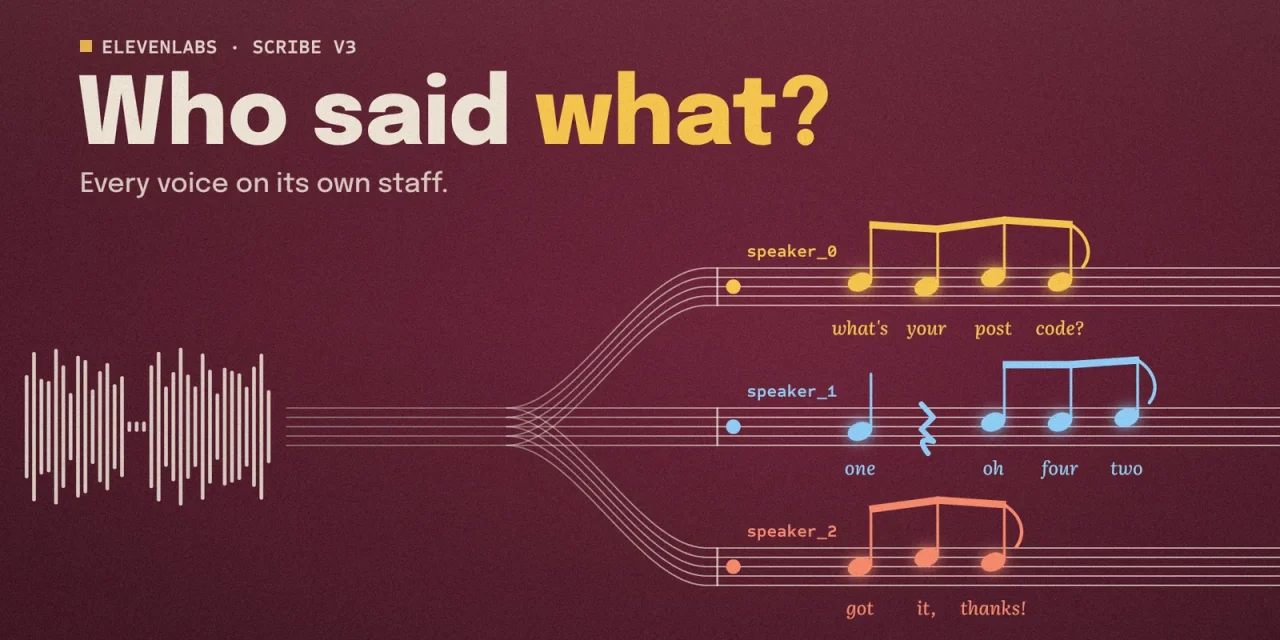
Scribe v3 is ElevenLabs’ new speech-to-text model for recorded audio, released on 10 November 2026 together with Scribe v3 Live for real-time audio. ElevenLabs says Scribe v3 makes 27% fewer word errors than Scribe v2 and labels speakers more accurately, at the same price of $0.20 per hour. An independent leaderboard now ranks it second of 64 models. For European teams, two questions matter more than the headline number: how well it handles your languages, and where your audio is processed. By default, that is the United States.
What Scribe v3 and Scribe v3 Live are
Both models replace their v2 predecessors, which stay available.
- Scribe v3 transcribes recorded audio: meetings, interviews, calls, lectures, podcasts. It separates up to 32 speakers, adds word-level timestamps, tags non-speech events such as laughter and can drop filler words. Files can be up to 5 GB and 15 hours long.
- Scribe v3 Live transcribes as people speak, for captions and voice agents built on ElevenLabs. It now labels speakers in real time, which its predecessor could not do.
Switching is a one-line change: set the model ID to scribe_v3 or scribe_v3_live and existing parameters keep working, according to the model documentation.
How much better it is, and who measured it
The headline figures come from ElevenLabs’ own announcement and documentation:
- On FLEURS, a set of short read sentences in 102 languages, Scribe v3’s word error rate falls from 16.94% to 12.38%. Every language counts equally, including low-resource ones, which is why the averages look high.
- Speaker labelling errors drop 12% overall and 17% on recordings with three or more speakers.
- Scribe v3 Live makes 43% fewer semantic errors, the mistakes that change meaning, than Scribe v2 Realtime. Plain word errors drop 31%.
Two caveats apply. FLEURS is clean read speech, not a noisy meeting with people talking over each other. And the 16-language dataset behind the speaker-labelling claims has not been published yet, although ElevenLabs says it will open-source it.
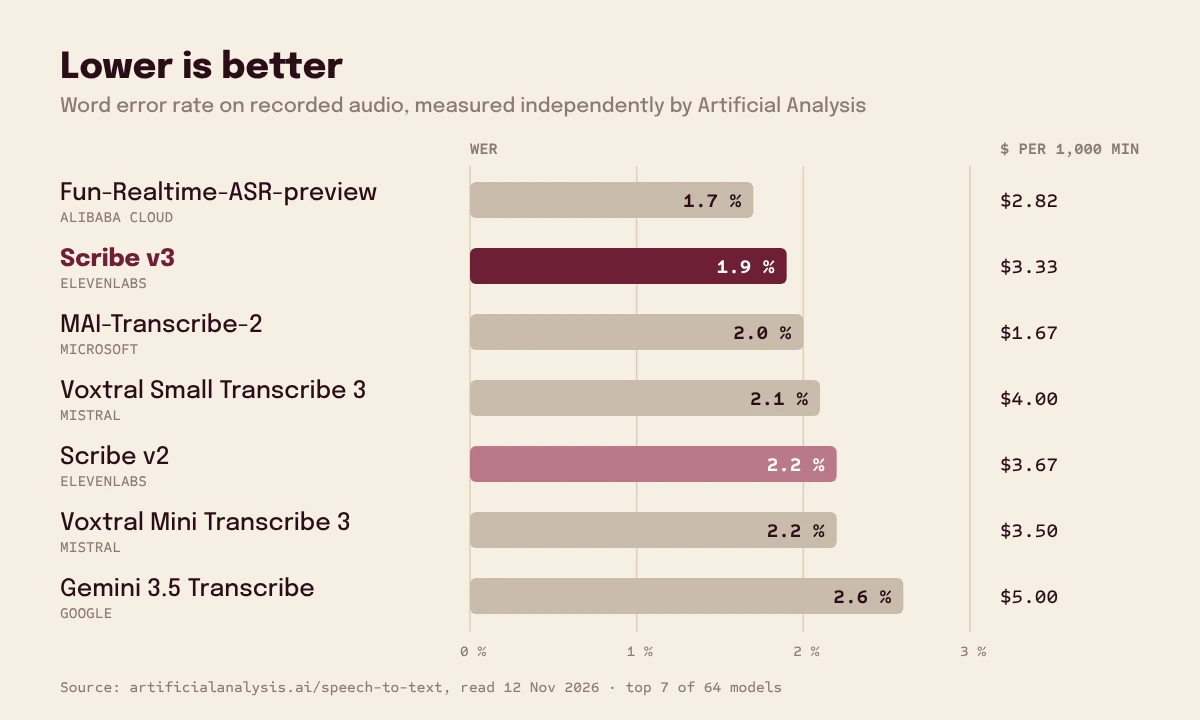
An outside view exists. On the Artificial Analysis speech-to-text leaderboard, read on 12 November, Scribe v3 is second of 64 models at 1.9%, behind a preview model from Alibaba Cloud at 1.7% and ahead of Microsoft’s MAI-Transcribe-2 at 2.0%, Mistral’s Voxtral Small Transcribe 3 at 2.1% and Scribe v2 at 2.2%.
The first third-party test of the live model came from Voice Arena, which ran it on more than 70 hours of unscripted phone calls. As summarised by CellCog, errors in Romanian fell from 21.2% to 7.3%, and in US English from 3.5% to 2.9%, where an AssemblyAI real-time model still led.
How it handles the EU’s 24 languages
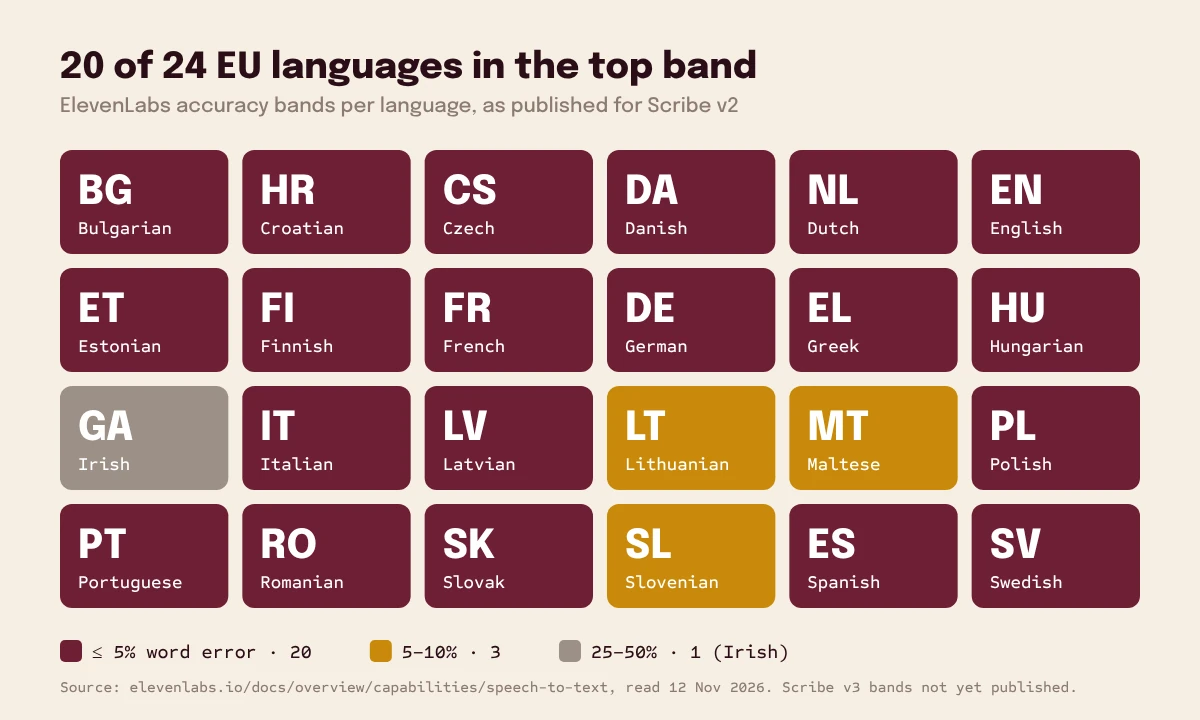
ElevenLabs has not published per-language results for Scribe v3 beyond a handful of examples: German improves by 42% and Spanish by 35%. Its language overview still shows the accuracy bands measured for Scribe v2, and the company says v3 improves on every language it tested. Applied to the official EU languages, those bands look like this:
- 20 languages at 5% word error or better: Bulgarian, Croatian, Czech, Danish, Dutch, English, Estonian, Finnish, French, German, Greek, Hungarian, Italian, Latvian, Polish, Portuguese, Romanian, Slovak, Spanish and Swedish.
- 3 between 5% and 10%: Lithuanian, Maltese and Slovenian.
- Irish sits in the weakest band, between 25% and 50%.
Two data points are directly European. On VoxPopuli, recordings of European Parliament speeches, the live model’s error rate drops from 2.13% to 1.71%. And Eneco, which supplies energy to more than two million homes and businesses in the Netherlands, tested Scribe v3 Live on real customer calls before launch: Dutch postcodes were recognised correctly on the first try 40% more often, house numbers 15% more often. The baseline is not given, so the absolute level is unknown.
Compare this with Nvidia’s open model, which covers 23 of the 24 EU languages but labels speakers in only six. Scribe v3 labels speakers in every language it supports, but you cannot run it yourself.
Why the postcode result matters
The Eneco test points at the feature that changes most in practice: turn detection. A classic voice line waits for silence and then decides you have finished. Pause in the middle of a postcode, and the system commits half of it while the agent starts talking. Scribe v3 Live also reads what has been said so far and predicts whether the sentence is complete. ElevenAgents already used this approach; it now sits inside the transcription model.
A multilingual mode handles people who switch language mid-sentence, common in Brussels, Luxembourg and most international teams. A keyterm library of up to 10,000 terms helps with product names, street names and medical vocabulary.
What Scribe v3 costs
Prices are unchanged from v2, according to the API pricing page read on 12 November 2026, excluding VAT:
| Model | Base price per hour | Keyterms | Transcript editing |
|---|---|---|---|
| Scribe v3 | $0.20 | +$0.05 | +$0.07 |
| Scribe v3 Live | $0.22 | +$0.08 | +$0.12 |
Silence is billed. A thousand hours of recorded meetings costs about $200 before add-ons. On the Artificial Analysis price comparison, MAI-Transcribe-2 costs roughly half as much per minute, while Voxtral Small Transcribe 3 and Gemini 3.5 Transcribe cost more.
Where your audio goes
This is where European buyers should slow down. Both models run in the US by default. ElevenLabs offers isolated environments in the EU, India and Singapore, but its data residency documentation sets clear limits:
- Data residency is an Enterprise-only feature. Self-serve plans process in the US.
- The EU environment is a separate account with its own API key and its own endpoints. Agents, voices and settings do not migrate automatically.
- Storage stays in the region, but processing for support and content moderation may still happen outside it, by affiliates and subprocessors. Zero Retention Mode restricts that, but it is not switched on by default.
- Transcript editing is not available in isolated environments.
Under the GDPR, voices and what people say in a meeting or call are personal data. Before rolling Scribe v3 out, you need a data processing agreement, a lawful basis and notice for the people being recorded, and a transfer mechanism if audio leaves the EU. The same questions apply to the AI conversation recorders that many teams now carry into meetings. Under the AI Act, transcription in itself is not a high-risk use. Using transcripts to monitor or evaluate employees can be, because AI used to monitor and evaluate people at work is on the high-risk list.
A two-week pilot for European teams
- Pick ten real recordings per language you work in: a four-person meeting, a phone call, a strong accent, a noisy room, a call with code-switching.
- Write a reference transcript for a few minutes of each. Without one you are measuring impressions.
- Run Scribe v2, Scribe v3 and one competitor on the same clips. Voxtral is the obvious European alternative; MAI-Transcribe-2 is the price benchmark.
- Score what hurts: names, numbers, amounts and wrong speaker labels, not filler words.
- Repeat with a keyterm list to see what $0.05 per hour buys you.
- Decide on the deployment model before scaling: US processing with transfer safeguards, the Enterprise EU environment with Zero Retention Mode, or a self-hosted model for the most sensitive audio.
Frequently asked questions
What is the difference between Scribe v3 Live and Eleven Realtime?
Scribe v3 Live turns speech into text. Eleven Realtime is a full speech model for voice agents that listens, reasons and speaks. ElevenAgents uses Scribe v3 Live as the ears of such an agent.
How many speakers can Scribe v3 separate?
Up to 32 in recorded audio. Scribe v3 Live gives draft speaker labels while people talk and a final label after each committed segment.
Can I self-host Scribe v3?
No weights are released. ElevenLabs offers private deployment for large customers. If you need a model you run yourself, look at Nemotron 3.5 Transcribe or Mistral’s open models.
Is Scribe v3 available in the EU?
Yes, anyone in the EU can use it. Processing in the EU requires the Enterprise data residency environment.
Accuracy is rented, governance is yours
A drop from 4% to 2% word error removes roughly 180 wrong words from a one-hour meeting, ElevenLabs calculates. That is a real improvement, and it costs nothing extra. But the decision that will outlast this model is not which vendor tops the leaderboard this month; it is how you route sensitive audio, which contracts cover it and how you will test the next model. As we argued in models are rented, context is owned, the transcription model will change again. Build the pilot so that switching is the easy part.